
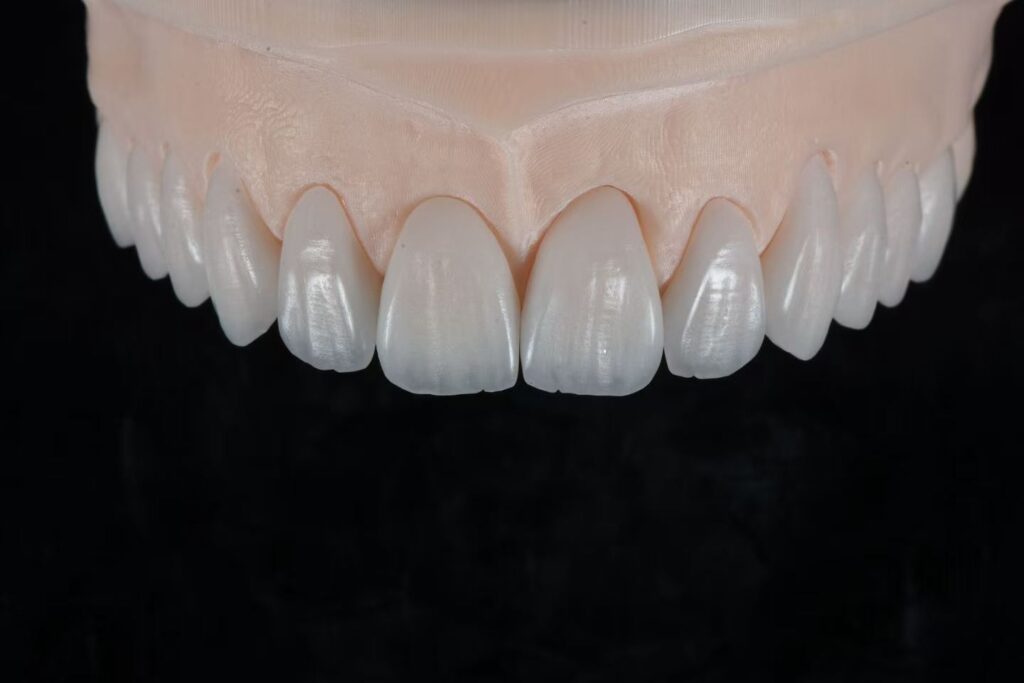
A reliable dental lab doesn’t wait until try-in to find out if a restoration fits. The review happens before production. At HeZhan Dental Lab, we check margins, bite records, scan quality, preparation clearance, and implant data before CAD design starts. Because reliability means catching problems early — not explaining them at the chair.
For a dentist, the most stressful moment is not a lab question before production. The real pressure starts when the restoration arrives, the patient is seated, and the case does not fit as expected.
The crown may not seat. The bite may feel high. The bridge may rock. The implant crown may not fully engage. The contact may feel too tight. At that point, the case already costs extra chair time, delays delivery, and creates a difficult conversation with the patient.
At HeZhan Dental Lab, we review case records before production begins. Our team checks margin visibility, bite relationship, scan quality, preparation clearance, implant information, material choice, prescription details, and clinical photos. A clean-looking STL file does not always mean the case is ready for predictable lab production.
Common Try-In Problems and What They Can Mean
| Try-In Problem | What the Dentist Sees | Possible Risk Before Production | What HeZhan Reviews |
|---|---|---|---|
| Crown does not seat | open margin, rocking, binding | unclear margin, undercut, contact issue, path-of-insertion problem | margin visibility, prep form, insertion path |
| Crown feels high | patient bites early on the new crown | bite scan error, unstable occlusion, opposing arch issue | bite relationship, opposing arch, occlusal contacts |
| Bridge rocks or binds | bridge does not seat passively | span distortion, tight contact, insertion path issue | bridge span, proximal contact, model accuracy |
| Implant crown does not seat | crown will not fully engage | scan body issue, wrong library, missing implant data | implant system, scan body, platform, library |
| Contact is too tight or open | dentist adjusts interproximal contact | adjacent tooth scan issue, CAD setting, production tolerance | proximal surfaces, contour, contact strength |
| Margin looks open | visible gap or poor adaptation | finish line unclear, tissue interference, over-trimming | finish line, soft tissue, margin design |
“Doesn’t Seat” and “Feels High” Are Different Problems
A restoration that does not seat usually points to a fit problem. The issue may involve the margin, contact, path of insertion, internal surface, preparation form, or implant component connection. The dentist may see an open margin, rocking, binding, or incomplete seating.
A restoration that feels high can seat fully and still create premature occlusal contact. High bite problems often come from bite records, opposing arch scans, occlusal design, or scan alignment.
A lab should separate these two complaints during case review. Treating every try-in issue as a general “fit problem” can hide the real cause and delay the correct solution.
1. A Reliable Lab Reviews Margin Clarity Before Design
For crown and bridge cases, the margin tells the technician where the restoration should end. If the finish line is hidden by blood, saliva, soft tissue, or a deep subgingival preparation, the CAD designer has to interpret incomplete data.
That interpretation affects marginal fit.
An unclear margin can lead to open margins, over-contoured edges, short margins, overextended margins, poor emergence profile, or extra chairside adjustment. The problem does not start at milling or finishing. It starts when the lab cannot read the clinical boundary with confidence.
Before design, HeZhan reviews whether the margin can be traced around the full preparation. If the margin area contains scan holes, tissue noise, unclear finish line sections, or distorted edges, our team flags the risk before production moves forward.
2. A Reliable Lab Verifies Bite Records Early
A crown can fit the model and still feel wrong in the patient’s mouth.
Bite records can create problems when the patient closes in an unstable position, the opposing arch scan is incomplete, the bite scan captures too small an area, or the upper and lower arches align incorrectly in the software. In single-unit cases, the dentist may adjust the occlusion chairside. In bridge, implant, and full-arch cases, a small bite error can create a larger delivery problem.
HeZhan checks the bite relationship before CAD design. Our technicians look for abnormal contact concentration, model intersection, floating occlusion, missing opposing surfaces, and bite alignment that does not match the prescription or case photos.
When the bite data looks questionable, the lab should clarify before producing the final restoration.
3. A Reliable Lab Checks Preparation Clearance
A good scan cannot fix a preparation that lacks restorative space.
Zirconia, lithium disilicate, porcelain-fused-to-metal, full metal, and implant restorations each need enough material thickness. The required clearance depends on the material, tooth position, restoration type, antagonist, and manufacturer guidance.
When the preparation has limited occlusal clearance, sharp internal angles, undercuts, or unsupported enamel, the technician has limited options. The lab may need to thin the restoration, flatten anatomy, adjust the occlusal design, change the material recommendation, or ask the clinic for clarification.
These compromises can affect strength, esthetics, occlusion, and final fit. That is why preparation review matters before production.
HeZhan reviews occlusal clearance, axial wall form, undercuts, margin design, path of insertion, and selected material before CAD/CAM work begins.
4. A Reliable Lab Validates Every STL File
An STL file can open correctly and still contain production risks.
Common digital scan problems include scan holes, stitching errors, soft tissue noise, missing interproximal data, distorted margins, incomplete opposing arch data, and unclear proximal surfaces. These issues matter more in long-span bridges, multiple-unit cases, implant cases, and cases with limited clearance.
A dental lab should not send every file directly into CAD. The first step is case review.
HeZhan checks whether the preparation is fully captured, whether the margin is readable from multiple views, whether adjacent teeth are clear, whether the opposing arch supports occlusal design, and whether the bite relationship is stable.
If the scan contains distortion near the margin, contact, or occlusal surface, the final restoration may reach the chair with a problem that could have been caught earlier.
5. A Reliable Lab Controls Contact Precision
Contact problems are common at try-in.
A tight contact can stop a crown or bridge from seating. An open contact can trap food and create patient complaints after delivery. Contact issues can come from adjacent tooth scan quality, model trimming, CAD design settings, material behavior, sintering shrinkage, milling tolerance, or finishing.
For outsourced dental lab work, contact control depends on both technical skill and case information. The technician needs clear adjacent tooth surfaces, accurate margins, stable model data, and the right design expectation.
HeZhan reviews proximal surfaces, contour, contact position, and path of insertion before production. For bridge cases, our team also checks whether the span can seat passively without binding on adjacent teeth.
6. Implant Restorations Need Complete Component Information
Implant restorations need more than a tooth-shaped scan.
For implant crowns and implant bridges, the lab needs accurate information about the implant system, platform, scan body, digital library, tissue contour, restorative space, and screw access position. If the scan body was not fully seated, the final crown may not seat. If the wrong library is used, the CAD design may not match the component.
Common implant case risks include:
- scan body not fully seated
- wrong scan body selected
- missing implant brand
- missing implant platform
- incorrect digital library
- poor tissue scan around the implant
- limited restorative space
- screw channel position problem
- multi-unit implant distortion
HeZhan reviews implant information before design. For multi-unit implant and full-arch cases, our team may recommend additional verification steps or prototype review before final restoration production.
7. The Prescription or Photos Did Not Give Enough Clinical Context
The lab cannot see the patient. It only sees the records.
A prescription that only says “zirconia crown A2” may not give enough information for esthetic, occlusal, or design decisions. Photos help the lab understand shade, stump color, adjacent tooth shape, smile line, tissue condition, occlusal wear, and case expectations.
For anterior cases, implant esthetic zones, shade-sensitive restorations, and complex full-mouth cases, missing photos can create avoidable communication problems.
HeZhan recommends sending shade photos, preparation photos, bite photos, smile photos, implant details, material preferences, and design notes when the case needs more than basic production.
How HeZhan Reviews Cases Before Production
HeZhan Dental Lab reviews digital and conventional cases before production begins. Our goal is to identify production risks while the case can still be corrected.
Our team checks:
- margin visibility
- preparation clearance
- bite relationship
- STL file integrity
- scan holes or distorted areas
- proximal contacts
- opposing arch data
- implant scan body information
- implant system and platform
- material selection
- shade photos
- prescription details
- case photos
When HeZhan identifies a case risk, our team contacts the clinic before moving the case forward. We point out the specific issue, such as unclear margin areas, bite alignment concerns, insufficient clearance, missing implant information, or scan distortion.
When needed, our team can use screenshots or marked scan views to show the area of concern. The purpose is to solve the risk before CAD design, milling, sintering, finishing, or shipping.
Before You Send a Crown, Bridge, or Implant Case
Use this checklist before submitting a case to an outsourced dental lab.
| Checkpoint | Question to Ask |
|---|---|
| Margin | Can the full finish line be traced without guessing? |
| Clearance | Does the preparation provide enough space for the selected material? |
| Bite | Does the bite record match the patient’s stable occlusion? |
| Opposing arch | Is the opposing arch complete enough for occlusal design? |
| Adjacent teeth | Are proximal surfaces captured clearly? |
| Implant data | Did you include implant brand, platform, scan body, and library information? |
| Photos | Did you send shade photos, prep photos, or case photos when needed? |
| Prescription | Did you explain material, shade, occlusion, design, and delivery expectations? |
Complete records help the lab make decisions before production. Missing records push those decisions into the try-in appointment.
FAQ
Why does my crown not seat at try-in?
A crown may not seat at try-in because of an unclear margin, tight contact, undercut, distorted scan, incorrect path of insertion, or internal fit issue. The lab should review the margin, contact, preparation form, and scan integrity before production.
Why does my crown feel high if the margin fits?
A crown can seat fully and still feel high when the bite record, opposing arch scan, or occlusal design does not match the patient’s mouth. A high bite is often an occlusion problem, not a margin problem.
Why does an implant crown not fully seat?
An implant crown may not fully seat when the scan body was not seated correctly, the implant library does not match the component, or implant system information is missing. Implant cases require accurate scan body, platform, and library data before CAD design.
Can a clear intraoral scan still produce a poor-fitting restoration?
Yes. A scan can look clean but still lack a readable margin, stable bite relationship, complete opposing arch, accurate proximal surfaces, or correct implant information. A lab should review the case data before treating the file as production-ready.
Should the dental lab ask questions before production?
Yes. A responsible dental lab should ask questions when the submitted records show unclear margins, limited clearance, bite concerns, scan distortion, or incomplete implant data. Early communication reduces avoidable remakes, chairside adjustment, and delays.
Reduce Try-In Surprises Before the Case Reaches the Chair
A try-in appointment should confirm the restoration, not reveal problems that the lab could have identified earlier.
HeZhan Dental Lab reviews margins, bite records, preparation clearance, scan integrity, implant data, material selection, and case instructions before production. This review helps clinics reduce avoidable remakes, chairside adjustments, and delivery delays.
Send your crown, bridge, implant, or removable case files to HeZhan Dental Lab. Our team reviews production records before CAD/CAM work begins.
Reviewed by HeZhan Dental Lab
HeZhan Dental Lab supports overseas dental clinics and dental laboratories with crown and bridge restorations, implant restorations, removable dentures, orthodontic appliances, and digital STL workflows.
HeZhan Dental Lab has 20+ years of export dental lab experience, 150+ technicians, and case support for clients in 15+ countries and regions. Our technical team reviews case records before production to identify risks related to fit, occlusion, margin clarity, implant data, material selection, and case instructions.