
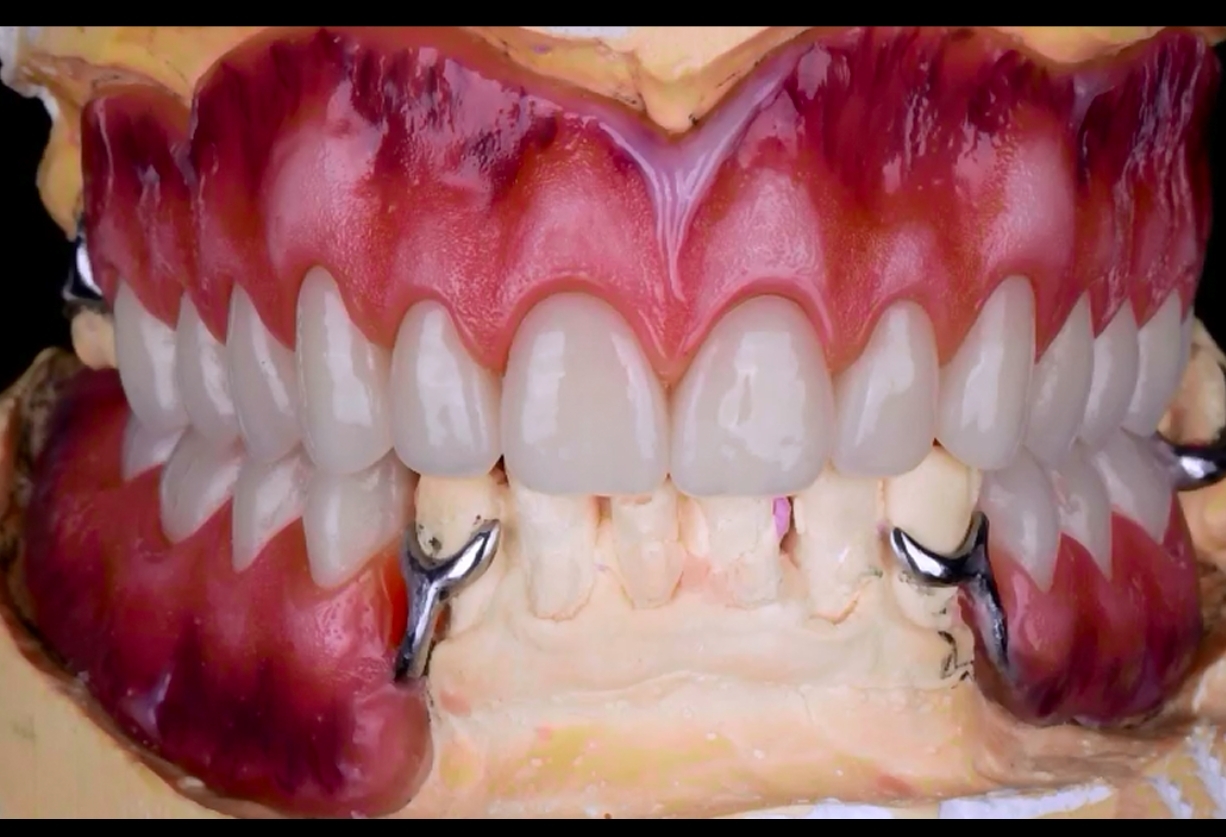
Precision Metal Frameworks for Predictable, Long-Term Outcomes
The Clinical Reality
A removable partial denture (RPD) can be one of the most satisfying restorations you deliver — or one of the most troublesome. The difference rarely comes down to the design alone. It comes down to how the framework behaves in the mouth, under load, over time.
When a rigid metal framework is designed and fabricated correctly, it does something that no flexible material can replicate: it controls movement. It directs occlusal forces toward abutments in a predictable pattern, limits soft-tissue displacement, and maintains retention without relying on tissue compression.
When rigidity is compromised — whether by material choice or execution — the prosthesis moves. And movement leads to sore spots, loosening, abutment stress, and accelerated ridge resorption.
At HeZhan Dental Lab, we approach every RPD framework case with this biomechanical reality in mind. Not as a “metal denture,” but as a support system — one that must integrate with the patient’s arch form, occlusion, and tissue condition to perform predictably over years, not months.
RPD Framework Design — Where Function Begins
A cast partial denture framework is not a single component. It is an integrated system of:
-
Major connectors — uniting the framework and providing cross-arch stabilization
-
Minor connectors — linking components to the major connector
-
Rests — directing occlusal forces along the long axis of abutment teeth
-
Clasps — providing retention through controlled engagement of undercuts
-
Denture base — supporting the artificial teeth and adapting to tissue
Each component must be designed in relation to the others. A well-designed RPD framework distributes load across multiple abutments, reducing localized stress and protecting both teeth and supporting tissues.
What this means for your cases: Fewer adjustments. Less tissue irritation. Retention that stays stable over time.
Material Options — Choose What Fits Your Clinical Need
| Material | Key Properties | Clinical Preference |
|---|---|---|
| Cobalt-Chromium (CoCr) | High rigidity, excellent fatigue resistance, castable to fine detail | Standard choice for most long-term RPD cases; performs well under heavy occlusion and parafunction |
| Titanium | Lightweight, highly biocompatible, corrosion-resistant | Preferred for patients with metal sensitivity or when reduced framework weight is desired |
Material selection matters — but framework design has a greater impact on long-term success than material choice alone. A well-designed CoCr framework will outperform a poorly designed titanium framework every time.
Clinical Scenarios We Address Regularly
Our cast RPD frameworks are designed for cases where predictable, long-term function is the priority:
Kennedy Class I & II (Bilateral / Unilateral Free-End Saddles)
The rigid major connector controls rotational and torsional forces — movement that flexible materials cannot manage. This protects abutment teeth and supporting tissues from excessive loading.
Long Edentulous Spans
Rigid frameworks maintain arch form and distribute forces across multiple abutments, reducing localized stress and limiting ridge resorption over time.
Heavy Occlusion or Bruxism
Cobalt-chromium frameworks resist distortion under repetitive loading. Clasp integrity and retention remain consistent, unlike flexible materials that fatigue and loosen.
Precision Attachment Cases
The metal framework provides a stable base for attachments, combination restorations, or implant-supported prosthetics.
Patients Not Suitable for Implants
For patients with insufficient bone, medical contraindications, or financial constraints, a well-designed cast RPD offers durable function and acceptable esthetics without invasive surgery.
What We Deliver — Beyond the Framework
When you send a case to HeZhan, you receive more than a finished cast partial denture. You receive:
1. Design That Anticipates Function
We evaluate each case for span length, abutment condition, occlusal scheme, and tissue support. Each framework is designed using surveyed models and strategic component placement — rests, clasps, connectors, and guiding planes working as a unified system.
2. Retention That Stays Stable
Retention in a cast partial denture should not degrade significantly over time. Our frameworks are designed with well-defined rest seats, positive guiding planes, and appropriate clasp placement that engage abutment teeth in a repeatable, controlled manner — not relying on tissue deformation for grip.
3. Esthetics Without Compromising Function
Tooth-colored clasps, thoughtful clasp placement, and hybrid framework designs allow us to reduce visible metal without sacrificing mechanical stability. When esthetics are the primary concern, we discuss options — but we do not recommend a material that cannot support the functional demands of the case.
4. Tissue-Friendly Finishing
A smooth, high-gloss finish on all tissue-contacting surfaces reduces plaque accumulation and soft-tissue irritation. Our finishing process is meticulous — not just for appearance, but for long-term tissue health.
Digital Workflow — Precision from Impression to Framework
Our RPD framework fabrication uses CAD/CAM design and digital surveying to improve accuracy and reduce chairside adjustments.
Digital impressions (STL files from most intraoral scanners) are accepted and processed alongside traditional physical models.
What this means for you:
-
Reduced remakes
-
Consistent fit across cases
-
Faster turnaround when needed
What We Need From You
Accurate framework fabrication begins with complete case information. To minimize adjustments and remakes, please include:
- Master model (surveyed, undercuts identified)
- Opposing model (articulated if possible)
- Bite registration (stable, accurate)
- Shade selection (VITA or equivalent)
- Design preferences (clasp type, finish line, any specific requirements)
- Clinical photos (optional — helpful for tissue assessment and esthetic planning)
We accept physical impressions and digital STL files from most intraoral scanners.
Our Commitment
-
Every framework is checked before casting. If we see a design issue or missing information, we contact you before proceeding — not after.
-
Standard turnaround: 7–10 business days. Rush service available upon request.
-
Fit guarantee: If a framework does not fit as designed, we remake it at no charge.
Submit Your Case
Fill in the form below with your contact information and case notes. We will respond with a quote, shipping instructions, and case confirmation.
About HeZhan Dental Lab
We are a full-service dental laboratory specializing in precision removable prosthetics. Cast partial dentures are one of our core competencies — not as a commodity service, but as a technically demanding restoration that requires clinical understanding, design expertise, and manufacturing precision.
We work with dental clinics and laboratories who value:
-
Clear, proactive communication
-
Consistent quality and turnaround
-
Technical guidance when needed
-
Accountability for every case we produce
If you are looking for a lab partner who treats your cases as we would treat our own — get in touch.